Affiliate Disclosure: Some links in the RVBN Business Book Library may be affiliate links. If you purchase through one of these links, RVBN may receive a small commission at no additional cost to you. We recommend books because we believe they may be useful to our members, Our members use our link to help support RVBN.
It's Not Just About How Much Money You Make
Most of us are taught a fairly traditional financial path: get an education, find a good job, earn more money, buy a home, save for retirement, and avoid unnecessary financial risk.
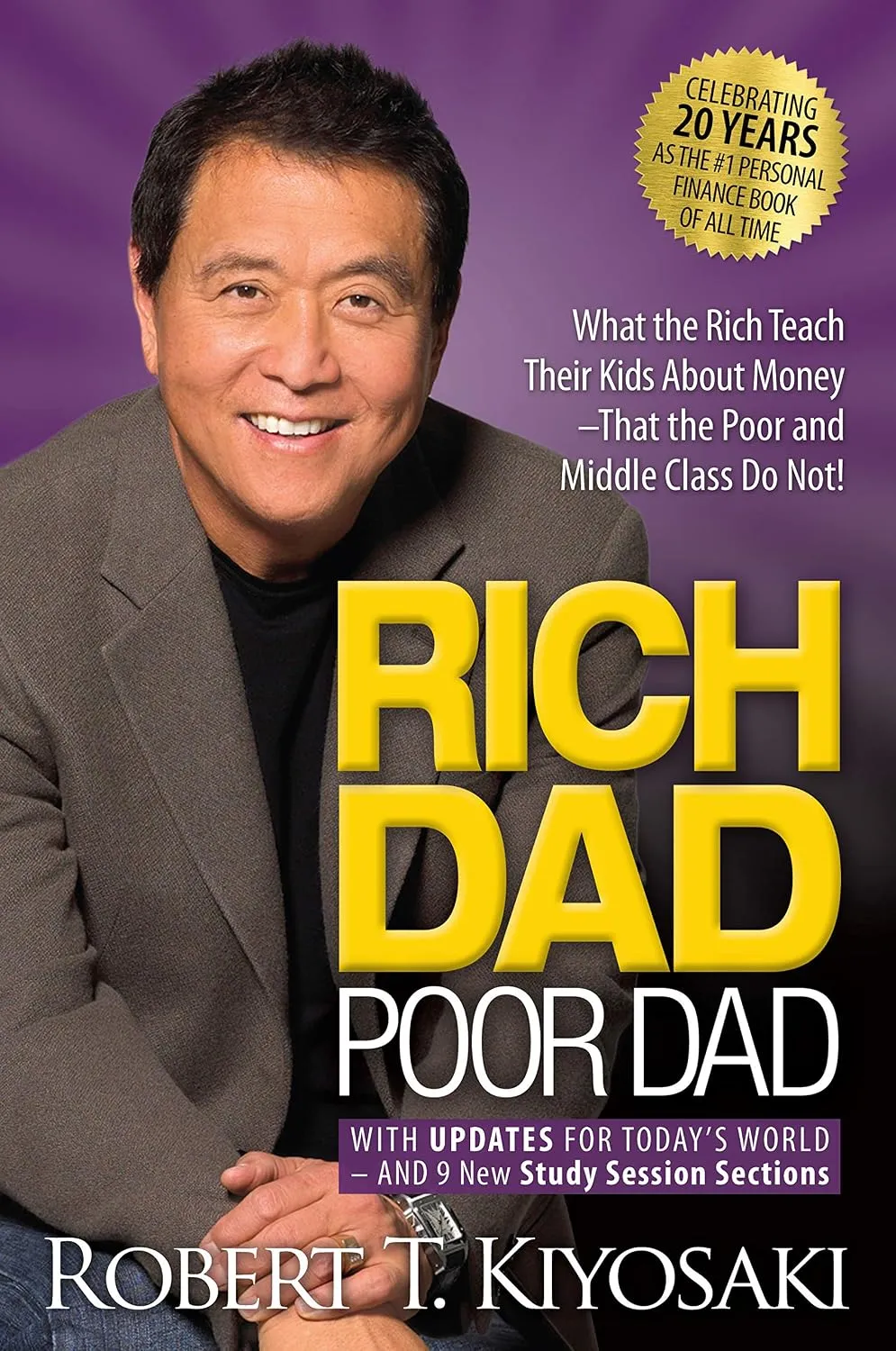
Rich Dad Poor Dad challenges many of those assumptions.
Robert Kiyosaki uses the contrasting lessons of his highly educated “poor dad” and financially successful “rich dad” to introduce a different way of thinking about work, income, assets, debt, and wealth.
Whether you agree with every conclusion or not, the book asks an important question:
Are you working for money—or are you building things that can eventually make money without depending entirely on your labor?
What This Book Is About
At its core, Rich Dad Poor Dad is a book about financial mindset and financial literacy.
Kiyosaki argues that earning a high income doesn't necessarily create wealth. What matters is what you do with the money after you earn it.
One of the book's central concepts is the distinction between assets and liabilities. Kiyosaki uses intentionally simple definitions: assets put money into your pocket, while liabilities take money out.
From that perspective, building wealth means gradually acquiring assets that produce income rather than continually increasing expenses as your income rises.
For entrepreneurs, this creates another interesting distinction: owning a business isn't necessarily the same thing as owning an asset. If the business can't operate without you constantly working in it, you may have created a job for yourself rather than something capable of producing income independently.
Why RVBN Recommends It
Rich Dad Poor Dad isn't an accounting textbook or a step-by-step financial plan. Some of its ideas are deliberately simplified, and readers shouldn't treat every claim as a universal financial rule.
Its value is in making you question assumptions about money.
For a small business owner, that's particularly useful.
Are you using the income from your business simply to increase your lifestyle? Are you building something with lasting value? Are you reinvesting intelligently? Are you creating systems, assets, and income streams that become less dependent on your personal labor?
A good business book doesn't always need to give you all the answers.
Sometimes it needs to make you ask better questions.
Who Should Read This Book?
This book may be especially useful if:
You were never really taught how money and wealth work.
You earn money but struggle to accumulate assets.
Your expenses tend to rise whenever your income rises.
You're interested in entrepreneurship or investing.
Your business depends almost entirely on your own labor.
You want to reconsider some traditional assumptions about financial success.
One Big Idea
Don't concentrate only on earning more. Concentrate on owning more things that produce value.
An entrepreneur can increase income by working more hours, taking more jobs, or finding more customers.
But there's a limit to how much one person can work.
Building systems, intellectual property, investments, recurring revenue, equipment that produces income, or a business capable of operating without your constant involvement changes the equation.
The goal becomes more than earning income.
It becomes building assets.
Put It Into Practice
Take an inventory of where your money and effort are currently going.
Ask yourself:
What assets do I currently own that produce income?
What expenses increase every time my income increases?
Am I building a business, or have I primarily created a job for myself?
If I stopped working for 30 days, what income would continue coming in?
What am I building today that could still have value five years from now?
Could some of today's income be used to acquire or create an asset instead of another expense?
You don't have to accept every idea in Rich Dad Poor Dad to benefit from it.
Its most useful contribution may simply be changing the question from:
“How can I make more money?”
to:
“What can I build or own that creates value over time?”